

Visual Correspondence & Geometric Matching
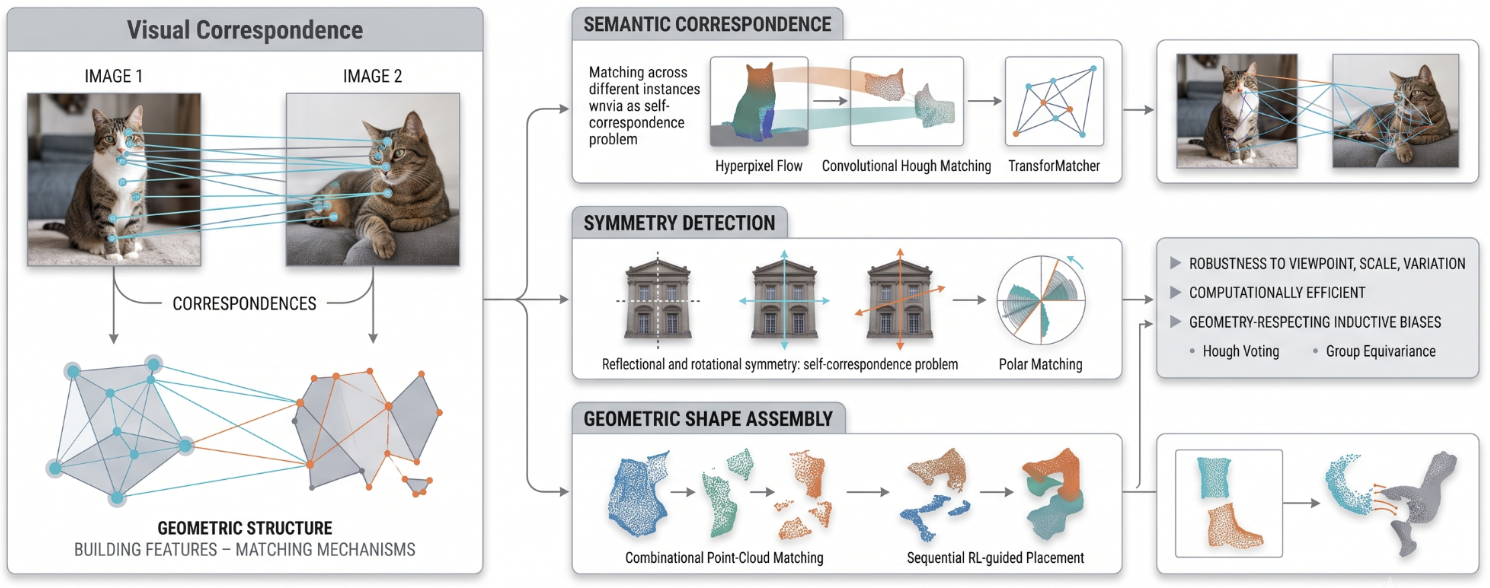
본문
Finding reliable correspondences between images, shapes, and point clouds is one of the lab's longest-running research threads, tracing back over a decade to early work on semantic correspondence with object proposals and continuing through today's group-equivariant formulations. The core problem is deceptively simple to state — given two visual observations of related content, which parts correspond to which? — but solving it robustly across viewpoint change, intra-class variation, symmetry, and partial observability has proven to be a deep and recurring research challenge.
The lab's approach treats correspondence not as a single task but as a family of problems that share a common computational core: building features and matching mechanisms that respect the geometric structure of the data in 2D or 3D space.
Semantic correspondence is the task of establishing a mapping between semantically corresponding parts across two images that depict different instances of the same or a related category — for example, matching the left ear of one cat to the left ear of another cat in a completely different pose. Given a pair of images as input, the output is a set of point-to-point matches (or a dense correspondence field) between them. At its core, this is a matching problem: the model must search over candidate correspondences between the two images and select the ones that are geometrically and semantically consistent, generalizing across appearance, viewpoint, and intra-class shape variation rather than matching identical pixel patterns as in stereo or optical flow.
Symmetry detection is the task of identifying the axes or planes of reflection and rotation symmetry present within a single image or 3D shape. Given one image or shape as input, the output is a set of symmetry parameters — a line or angle for 2D reflection, an axis and order for rotation, or a plane in 3D — describing the transformation under which the object maps onto itself. This is naturally a matching problem in disguise: rather than matching between two separate images, it matches an object against a geometrically transformed copy of itself, so the same correspondence-search machinery that pairs points across two images can be repurposed to pair points within a single one.
Geometric shape assembly is the task of reassembling a set of fragmented parts — such as broken pottery pieces or disassembled furniture components — into their original, coherent whole. Given a set of unordered fragment point clouds as input, the output is a rigid transformation (rotation and translation) for each fragment that correctly places it relative to the others. This extends matching from individual points or pixels to entire surfaces: solving it requires matching which fragment boundaries correspond to which across the whole set, turning assembly into a large-scale, combinatorial correspondence problem over pairs (and groups) of fragments rather than a single point-to-point search.
Across all three strands, the unifying methodological commitment is building matching systems that are robust to viewpoint, scale, and structural variation while remaining computationally efficient — favoring geometry-respecting inductive biases (Hough voting, group equivariance) over brute-force data-driven matching.
Related papers
Juhong Min, Jongmin Lee, Jean Ponce, Minsu Cho. Hyperpixel Flow: Semantic Correspondence with Multi-layer Neural Features. ICCV, 2019
Juhong Min, Jongmin Lee, Jean Ponce, Minsu Cho. Learning to Compose Hypercolumns for Visual Correspondence. ECCV, 2020
Juhong Min, Minsu Cho. Convolutional Hough Matching Networks. CVPR, 2021 (Oral)
Seungwook Kim, Juhong Min, Minsu Cho. TransforMatcher: Match-to-Match Attention for Semantic Correspondence. CVPR, 2022
Juhong Min, Seungwook Kim, Minsu Cho. Convolutional Hough Matching Networks for Robust and Efficient Visual Correspondence. TPAMI, 2023
Chunghyun Park*, Seungwook Kim*, Jaesik Park, Minsu Cho. Learning SO(3)-Invariant Semantic Correspondence via Local Shape Transform. CVPR, 2024
Ahyun Seo*, Woohyeon Shim*, Minsu Cho. Learning to Discover Reflection Symmetry via Polar Matching Convolution. ICCV, 2021
Jongmin Lee, Byungjin Kim, Seungwook Kim, Minsu Cho. Learning Rotation-Equivariant Features for Visual Correspondence. CVPR, 2023
Wongyun Yu, Ahyun Seo, Minsu Cho. Axis-level Symmetry Detection with Group-equivariant Representation. ICCV, 2025
Jongmin Lee, Byungjin Kim, Minsu Cho. Self-Supervised Equivariant Learning for Oriented Keypoint Detection. CVPR, 2022
Junha Lee, Seungwook Kim, Minsu Cho, Jaesik Park. Deep Hough Voting for Robust Global Registration. ICCV, 2021
Nahyuk Lee*, Juhong Min*, Junha Lee, Seungwook Kim, Kanghee Lee, Jaesik Park, Minsu Cho. 3D Geometric Shape Assembly via Efficient Point Cloud Matching. ICML, 2024
Nahyuk Lee*, Juhong Min*, Junhong Lee, Chunghyun Park, Minsu Cho. Combinative Matching for Geometric Shape Assembly. ICCV, 2025 (Highlight)

