

Open-Vocabulary Scene Understanding
본문
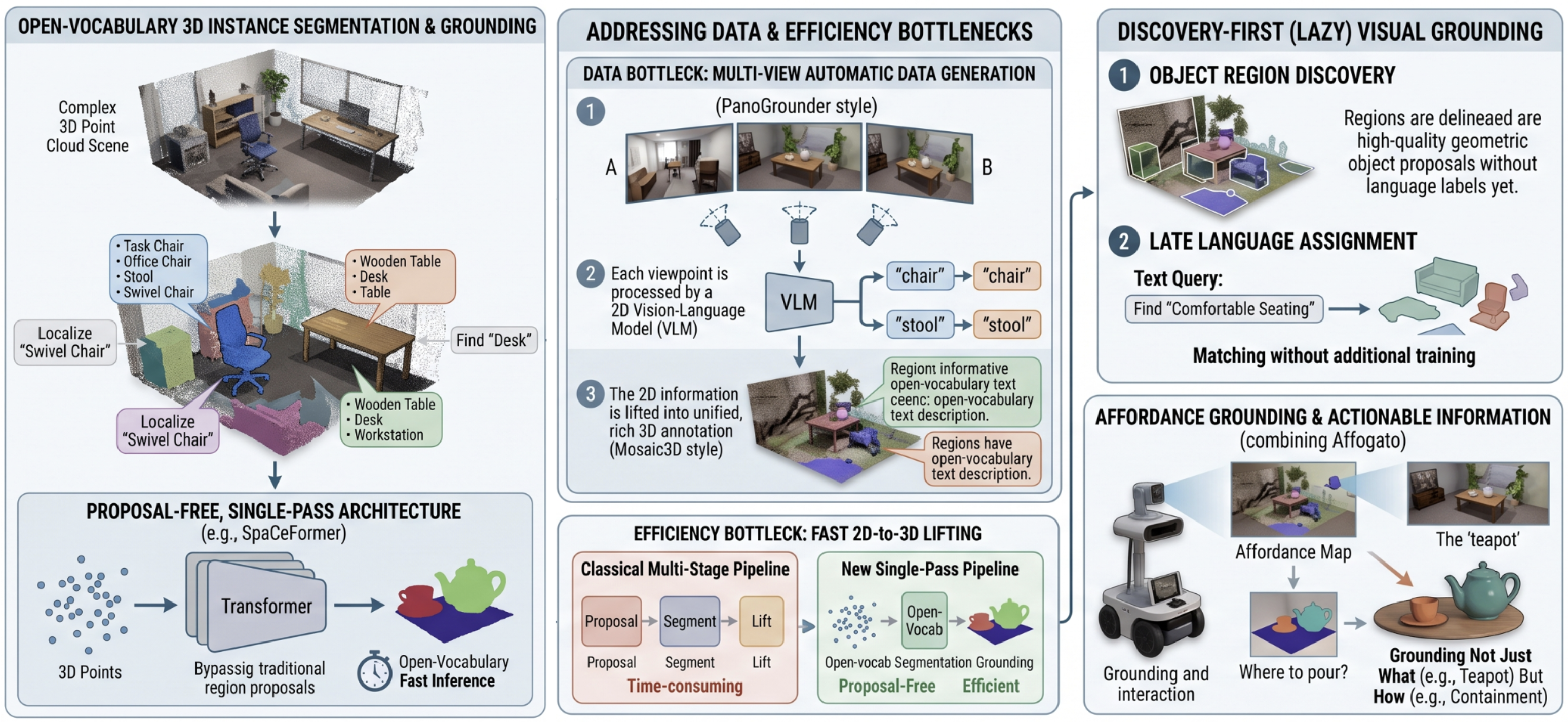
At the lab, this paradigm is pursued primarily in 3D scene understanding, where extending open-vocabulary recognition from 2D images to 3D scenes introduces its own data and efficiency bottlenecks. One line of work tackles the data bottleneck, building large-scale pipelines that automatically generate 3D region-text annotations from multi-view images and vision-language models, since manually labeling 3D scenes with open-ended language is prohibitively expensive. A second line tackles the efficiency bottleneck, replacing slow multi-stage pipelines that lift 2D predictions into 3D with proposal-free, single-pass architectures that segment a scene by open-vocabulary category directly and far faster. A third line questions how much text supervision segmentation actually needs up front, showing that discovering object regions visually first and only later assigning language labels can match or exceed classification-first approaches without additional training. This same open-vocabulary grounding machinery is also extended from generic object categories to actionable affordances, grounding not just what an object is but how it can be used.
Across these approaches, the shared commitment is decoupling what a model can recognize from a fixed training vocabulary, and doing so efficiently enough — in data construction, inference speed, and viewpoint coverage — to make open-vocabulary 3D perception usable as an infrastructure layer for downstream tasks, including embodied and robotic agents that must interact with categories no fixed label set could anticipate.
Related papers
Chris Choy, Junha Lee, Chunghyun Park, Minsu Cho, Jan Kautz. SpaCeFormer: Fast Proposal-Free Open-Vocabulary 3D Instance Segmentation. ICML, 2026
Junha Lee*, Chunghyun Park*, Jaesung Choe, Yu-Chiang Frank Wang, Jan Kautz, Minsu Cho, Chris Choy. Mosaic3D: Foundation Dataset and Model for Open-Vocabulary 3D Segmentation. CVPR, 2025
Seongmin Jung, Seongho Choi, Gunwoo Jeon, Minsu Cho, Jongwoo Lim. PanoGrounder: Bridging 2D and 3D with Panoramic Scene Representations for VLM-based 3D Visual Grounding. ECCV, 2026
Junha Lee*, Eunha Park*, Chunghyun Park, Dahyun Kang, Minsu Cho. Affogato: Learning Open-Vocabulary Affordance Grounding with Automatic Data Generation at Scale. ECCV, 2026
Dahyun Kang, Minsu Cho. In Defense of Lazy Visual Grounding for Open-Vocabulary Semantic Segmentation. ECCV, 2024

