

Scene Graphs & Human-Centric Scene Parsing
본문
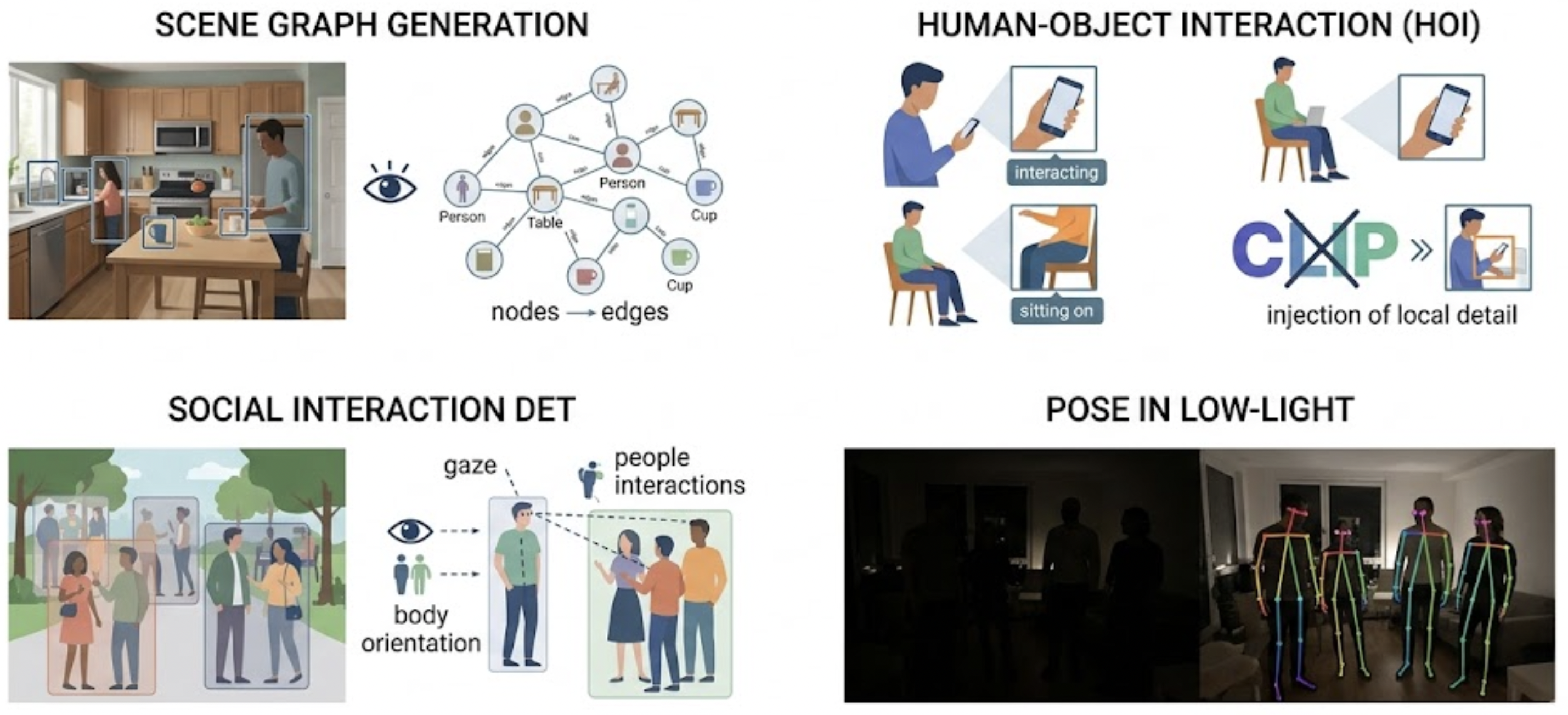
The central technical difficulty scene graph generation poses is combinatorial: given every possible pair of detected objects in an image, only a small fraction have a meaningful relationship, and treating every candidate pair as equally worth reasoning about drowns out the handful that matter. The lab's approach to general scene graph generation tackles this directly by decoupling the problem into two stages — first selecting which object pairs are plausible edges worth reasoning about at all, and only then applying rich contextual attention, jointly over node-to-node, node-to-edge, edge-to-node, and edge-to-edge relations, to disambiguate what the relationship actually is. This same edge-selection-then-context structure reappears once the entities are specifically human. Human-object interaction (HOI) detection is a scene graph restricted to a single, well-defined relation type — a person acting on an object — and the lab's work here moves from a rich context-exchange architecture that lets human, object, and interaction branches inform each other through unary, pairwise, and ternary relations, toward zero-shot settings where the challenge becomes adapting large vision-language models like CLIP — strong at coarse image-level semantics but weak on the fine-grained local detail needed to tell interactions apart — by injecting locality and interaction awareness directly into their representations. Group and social interaction detection extends the graph one level further, parsing not just pairwise relations but cluster structure among people: first building a practical benchmark and model for detecting an unknown number of social groups and their activities in realistic scenes, then pushing further to a bottom-up formulation that infers groups from fine-grained interpersonal cues like body parts and gaze rather than treating each person as a single holistic node. Beneath all of this sits a prerequisite: a scene graph over people is only as good as the perception of the people themselves, which motivates the lab's work on human pose estimation robust to extremely low-light conditions, built on a dedicated camera system and paired well-lit/low-light dataset.
Across these strands, the shared commitment is parsing visual scenes into structured, relational representations — general object graphs and their human-centered specializations alike — rather than treating a scene as an unstructured collection of independent detections.
Related papers
Dongkeun Kim, Minsu Cho, Suha Kwak. Part-Aware Bottom-Up Group Reasoning for Fine-Grained Social Interaction Detection. NeurIPS, 2025
Sanghyun Kim, Deunsol Jung, Minsu Cho. Locality-Aware Zero-Shot Human-Object Interaction Detection. CVPR, 2025
Dongkeun Kim, Youngkil Song, Minsu Cho, Suha Kwak. Towards More Practical Group Activity Detection: A New Benchmark and Model. ECCV, 2024
Sohyun Lee, Jaesung Rim, Boseung Jeong, Geonu Kim, Byungju Woo, Haechan Lee, Sunghyun Cho, Suha Kwak. Human Pose Estimation in Extremely Low-Light Conditions. CVPR, 2023
Deunsol Jung, Sanghyun Kim, Won Hwa Kim, Minsu Cho. Devil's on the Edges: Selective Quad Attention for Scene Graph Generation. CVPR, 2023
Sanghyun Kim, Deunsol Jung, Minsu Cho. Relational Context Learning for Human-Object Interaction Detection. CVPR, 2023

