

Symmetry Analysis & Equivariant Learning
본문
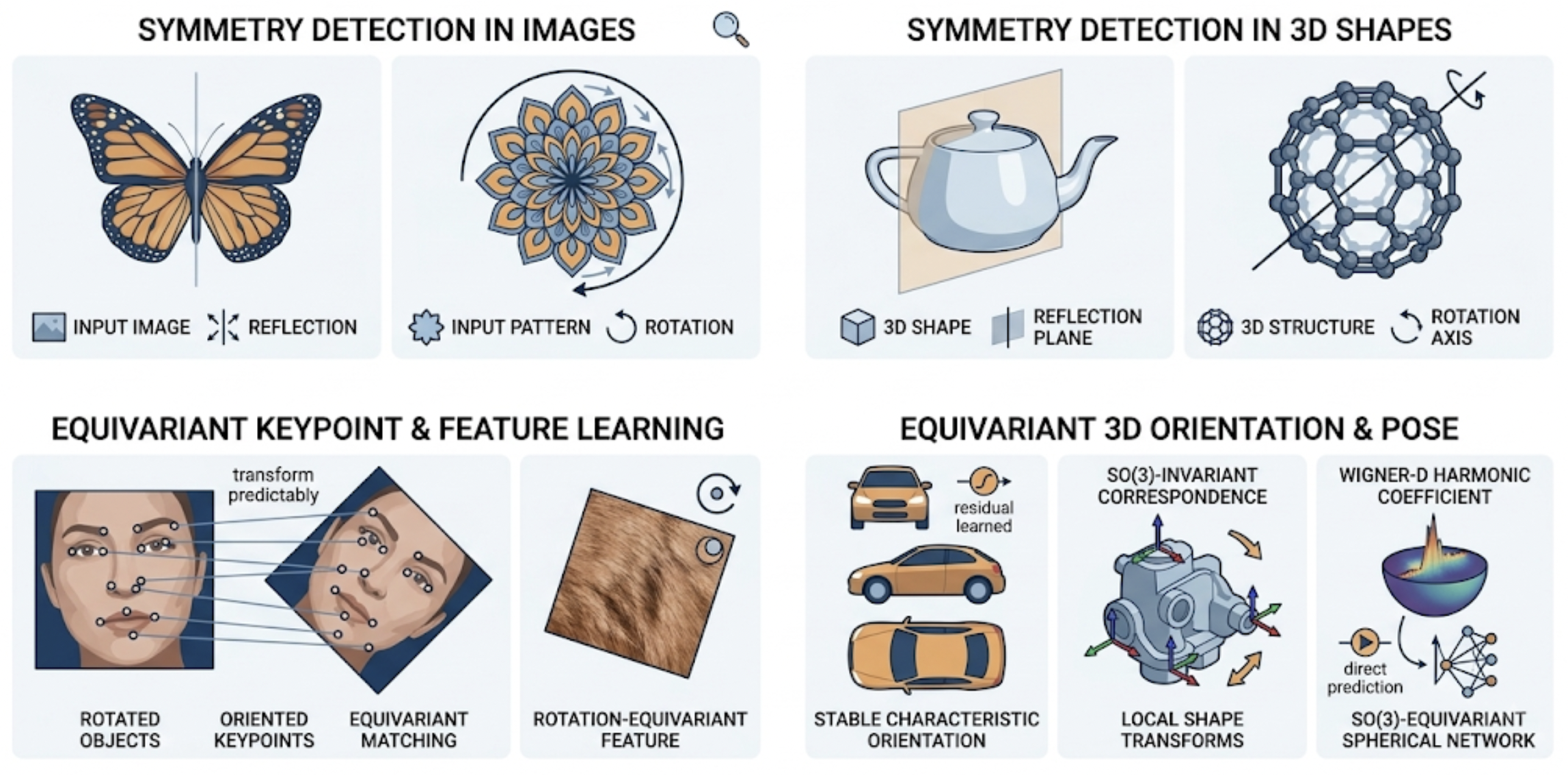
The symmetry detection strand asks where the axes or planes of reflection and rotation symmetry lie within a single image or 3D shape — treating it as a kind of self-correspondence problem, since detecting symmetry means matching a pattern against a transformed copy of itself. This work progresses from a polar matching formulation for 2D reflection symmetry, to an equivariant-learning approach that handles both reflection and rotation symmetry within one framework, to leveraging 3D geometric priors to make 2D rotation symmetry detection more reliable, to detecting symmetry axes directly through group-equivariant representations, and extending toward the related problem of few-shot pattern detection more broadly.
The equivariant representation learning strand takes the complementary approach of building the transformation structure directly into the network rather than discovering it after the fact. This includes learning keypoint detectors that are equivariant to orientation through self-supervision, extending rotation-equivariant features into general visual correspondence, learning 3D object orientation in a way that stays stable and consistent under different views through invariant residual learning, making semantic correspondence invariant to 3D pose via local shape transforms, and — most recently — predicting 3D rotations directly as Wigner-D harmonic coefficients in the frequency domain, so that the output representation itself is naturally compatible with SO(3)-equivariant spherical networks rather than being awkwardly bolted onto them.
Across both strands, the shared commitment is treating symmetry and equivariance not as incidental properties to be learned implicitly from data, but as structure that should be explicitly detected or explicitly built into a network's representations and outputs.
Related papers
Wongyun Yu, Ahyun Seo, Minsu Cho. Axis-level Symmetry Detection with Group-equivariant Representation. ICCV, 2025
Eunchan Jo, Dahyun Kang, Sanghyun Kim, Yunseon Choi, Minsu Cho. Few-Shot Pattern Detection via Template Matching and Regression. ICCV, 2025 (highlight)
Ahyun Seo, Minsu Cho. Leveraging 3D Geometric Priors in 2D Rotation Symmetry Detection. CVPR, 2025
Chunghyun Park*, Seungwook Kim*, Jaesik Park, Minsu Cho. Learning SO(3)-Invariant Semantic Correspondence via Local Shape Transform. CVPR, 2024
Jongmin Lee, Minsu Cho. 3D Equivariant Pose Regression via Direct Wigner-D Harmonics Prediction. NeurIPS, 2024
Seungwook Kim*, Chunghyun Park*, Yoonwoo Jeong, Jaesik Park, Minsu Cho. Stable and Consistent Prediction of 3D Characteristic Orientation via Invariant Residual Learning. ICML, 2023
Jongmin Lee, Byungjin Kim, Seungwook Kim, Minsu Cho. Learning Rotation-Equivariant Features for Visual Correspondence. CVPR, 2023
Ahyun Seo, Byungjin Kim, Suha Kwak, Minsu Cho. Reflection and Rotation Symmetry Detection via Equivariant Learning. CVPR, 2022
Jongmin Lee, Byungjin Kim, Minsu Cho. Self-Supervised Equivariant Learning for Oriented Keypoint Detection. CVPR, 2022
Ahyun Seo*, Woohyeon Shim*, Minsu Cho. Learning to Discover Reflection Symmetry via Polar Matching Convolution. ICCV, 2021

