

Actions, Events & Long-Horizon Reasoning from Videos
본문
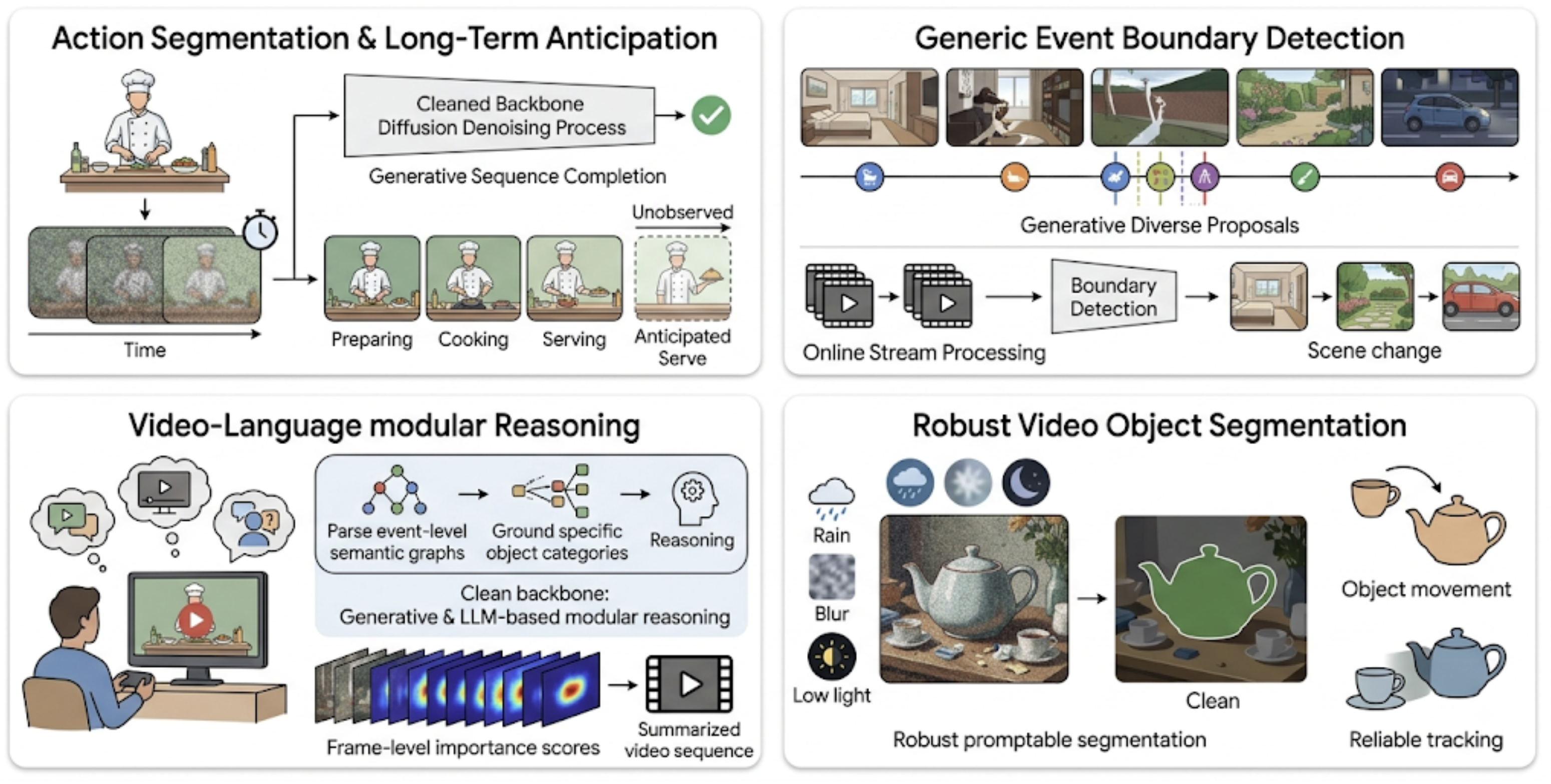
This program spans several closely related problems. One line unifies action segmentation and long-term action anticipation, treating both as instances of a single sequence-completion problem — segmenting the observed part of a video while generating plausible predictions for its unobserved future — first through a query-based transformer and more recently through a diffusion model that handles both visible and invisible portions of a sequence within one framework. A second line detects generic event boundaries, the natural points where a video shifts from one meaningful unit to the next; because human annotators often disagree on exactly where these boundaries fall, this work moves from a single deterministic prediction toward a generative formulation that produces diverse, plausible boundaries, and separately toward processing video boundaries online as it streams in rather than after the fact. A third line tackles video-language reasoning, decomposing complex video question answering into interpretable modular stages of event parsing, grounding, and reasoning rather than a single opaque model, and using large language models to evaluate and aggregate frame importance for coherent video summarization. A fourth line addresses video object segmentation, extending promptable segmentation to remain robust under real-world visual corruptions rather than assuming clean, idealized video input.
Across these strands, the shared thread is representing temporal structure — segments, boundaries, questions, and object identities — through generative and language-model-based reasoning, treating time itself as something to be modeled probabilistically and interpretably rather than predicted as a single deterministic output.
Related papers
Sohyun Lee, Yeho Gwon, Lukas Hoyer, Konrad Schindler, Christos Sakaridis, Suha Kwak. Robust Promptable Video Object Segmentation. CVPR, 2026
Min Jung Lee, Dayoung Gong, Minsu Cho. Video Summarization with Large Language Models. CVPR, 2025
Hyung Rok Jung*, Daneul Kim*, Seunggyun Lim, Jeany Son, Jonghyun Choi (*equal contribution). Online Generic Event Boundary Detection. ICCV, 2025
Jaejun Hwang, Dayoung Gong, Manjin Kim, Minsu Cho. Generic Event Boundary Detection via Denoising Diffusion. ICCV, 2025
Juhong Min, Shyamal Buch, Arsha Nagrani, Minsu Cho, Cordelia Schmid. MoReVQA: Exploring Modular Reasoning Models for Video Question Answering. CVPR, 2024
Dayoung Gong, Suha Kwak, Minsu Cho. ActFusion: A Unified Diffusion Model for Action Segmentation and Anticipation. NeurIPS, 2024
Dayoung Gong, Joonseok Lee, Manjin Kim, Seong Jong Ha, Minsu Cho. Future Transformer for Long-term Action Anticipation. CVPR, 2022

