

Relational Representation Learning for Video Understanding
본문
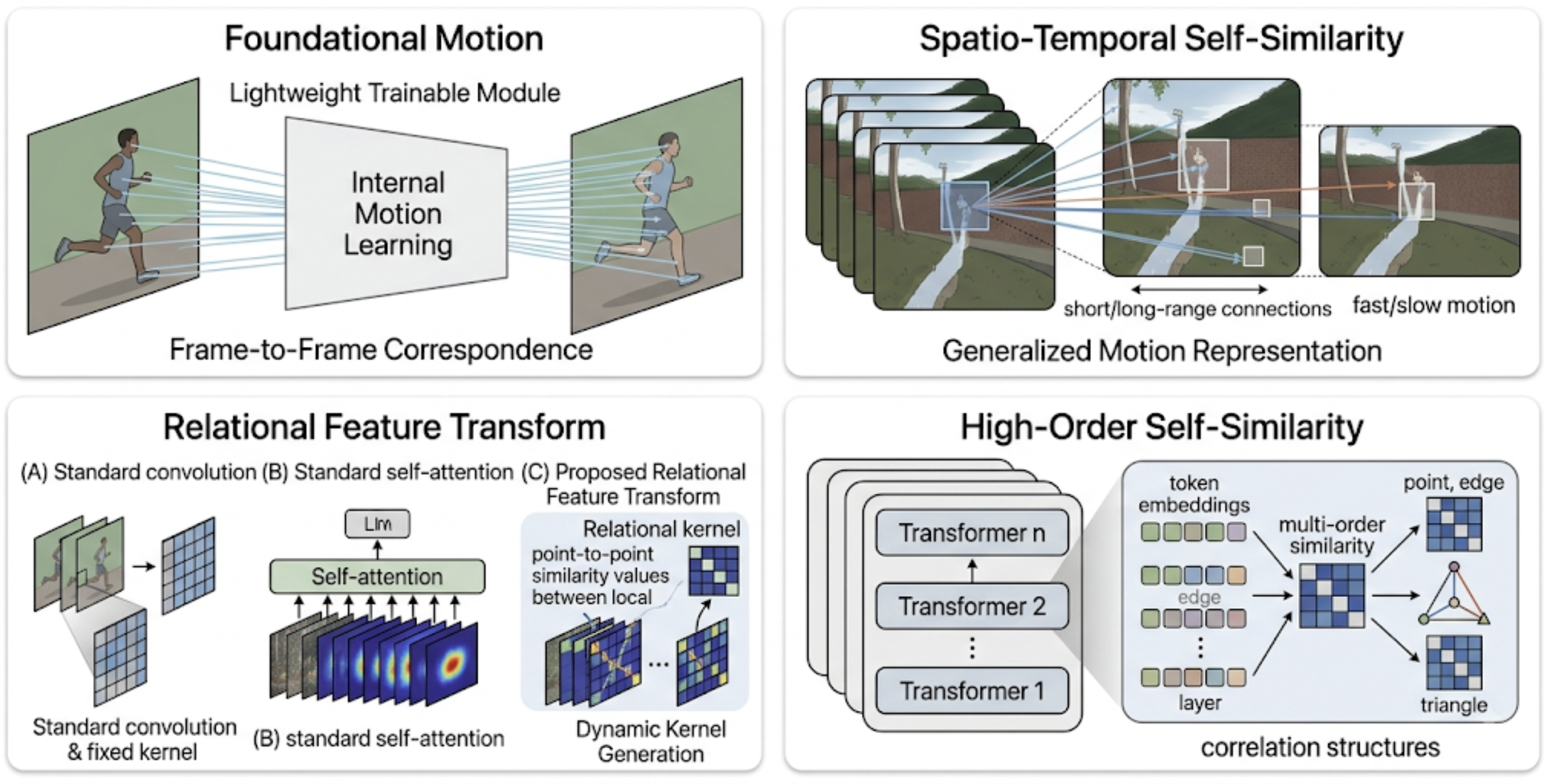
This program traces a clear conceptual progression. It begins by replacing the standard practice of pre-computing external optical flow — expensive and disconnected from the rest of the network — with a lightweight, trainable module that learns to establish frame-to-frame correspondences internally and convert them directly into motion features. The next step generalizes this idea beyond simple two-frame correspondence into a richer representation built on spatio-temporal self-similarity: each local region is represented not by its raw appearance but by its pattern of similarity to neighboring regions in space and time, which captures long-range and fast motion far more robustly than fixed convolutional kernels. This self-similarity idea is then reframed as a general feature transform problem, arguing that both convolution and self-attention are fundamentally limited for video because neither dynamically models the relational, correspondence-like structure that motion requires — leading to a relational feature transform that generates kernels from spatio-temporal relations directly. The most recent work in this line extends self-similarity to higher orders and to structured correlation patterns across vision transformer layers, pushing the same relational principle into modern transformer-based backbones.
Across this progression, the unifying commitment is treating motion and structure not as incidental byproducts of deep appearance features, but as an explicit, relational representation problem — one that recurs whether the underlying architecture is a convolutional network, an attention module, or a vision transformer.
Related papers
Heeseung Kwon, Manjin Kim, Suha Kwak, Minsu Cho. MotionSqueeze: Neural Motion Feature Learning for Video Understanding. ECCV, 2020
Heeseung Kwon*, Manjin Kim*, Suha Kwak, Minsu Cho (*equal contribution). Learning Self-Similarity in Space and Time as Generalized Motion for Video Action Recognition. ICCV, 2021
Manjin Kim*, Heeseung Kwon*, Chunyu Wang, Suha Kwak, Minsu Cho (*equal contribution). Relational Self-Attention: What's Missing in Attention for Video Understanding. NeurIPS, 2021
Manjin Kim, Paul Hongsuck Seo, Cordelia Schmid, Minsu Cho (*corresponding authors: Seo and Cho). Learning Correlation Structures for Vision Transformers. CVPR, 2024
Manjin Kim*, Heeseung Kwon*, Karteek Alahari, Minsu Cho (*equal contribution). Exploring High-Order Self-Similarity for Video Understanding. Under review, 2025/2026

